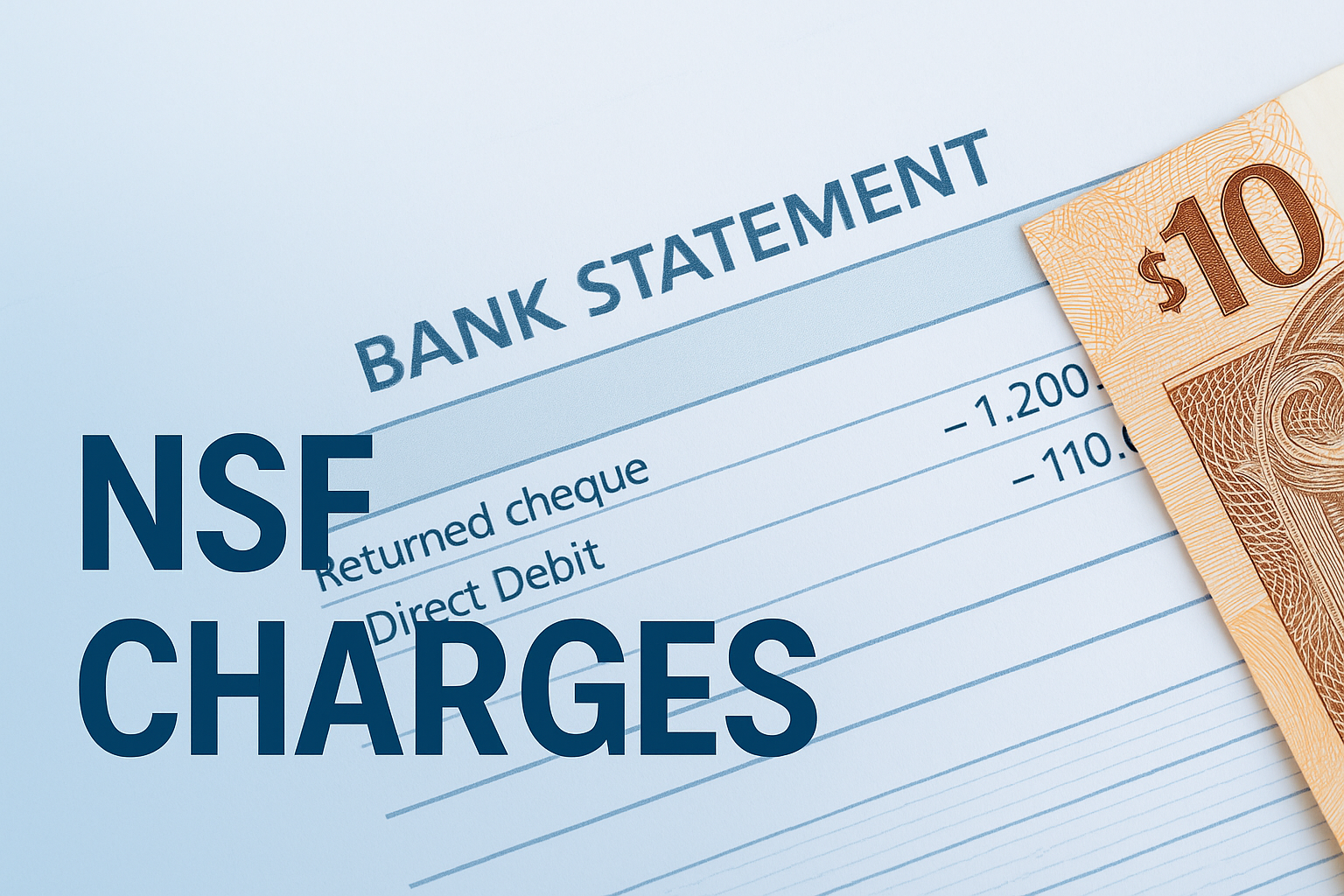
Most business owners don’t realize how much NSF charges, overdrafts, and bounced payments affect loan approvals. You can have strong revenue, good customers, and steady demand — but if your bank statements show frequent NSFs, lenders will treat your file as high-risk instantly.
This article explains exactly how lenders read NSFs, what counts as acceptable, what becomes a problem, and what you should fix before applying for a business loan.
What NSF Activity Tells a Lender
An NSF (non-sufficient funds) entry appears when a payment tries to clear your account but you don’t have enough money at that moment. Even if the situation is fixed later, the NSF remains on the statement.
To a lender, NSF activity signals one or more of the following:
- You operate with very tight cash flow
- You may struggle to handle fixed weekly or monthly loan payments
- Your account management might be inconsistent
- Your business has higher risk of default
- You may be relying on quick cash to cover gaps
Even if your revenue is strong, underwriters always flag NSF activity because it directly reflects how you manage cash day-to-day.
The Real Question: How Many NSFs Is “Too Many”?
There is no single universal number, but industry norms are extremely consistent across banks, SBA lenders, and private lenders.
0 NSFs
Perfect. This makes your file stronger instantly.
1 NSF in the last 3 months
Usually fine. A lender may ignore it if the rest of your profile is clean.
2–3 NSFs in the last 3 months
Borderline. Some lenders will still consider you, but they will look deeper into:
- your average balance
- your cash flow pattern
- whether the NSFs were small or large
- how quickly they were corrected
4+ NSFs in the last 3 months
This is where approvals start collapsing.
Most lenders consider this a sign of unstable cash flow or poor cash management.
5+ NSFs in a single month
Nearly automatic decline with traditional lenders.
Alternative lenders may still consider you — but at higher rates, lower approvals, and stricter structures.
Continuous weekly NSFs
This is viewed as “structural cash flow instability.” Even high-revenue businesses can get rejected for this pattern.
Why Lenders Care So Much About NSFs
Because NSFs tell the truth.
Tax returns can be managed. Bookkeeping can be adjusted. But bank statements show how you operate in real time.
NSFs reveal:
- whether you manage expenses proactively
- whether you overspend
- whether you run your business from the edge of your balance
- whether you can handle debt obligations
- whether your daily operations are predictable or chaotic
To a lender, NSFs are one of the strongest predictors of repayment reliability.
How NSFs Affect Loan Amounts and Terms
Even if you don’t get declined outright, NSFs still reduce borrowing power.
Lower loan amounts
If a lender sees NSFs, they reduce the approval amount so your payment stays lower and less risky.
Higher pricing
Riskier profile = higher cost of capital.
Stricter terms
You may get:
- shorter terms
- more frequent payments
- tighter monitoring
- lower credit lines
Extra documentation
Some lenders will request:
- updated financials
- business explanation letters
- revised bank statements
If your file has strong revenue but messy statements, a lender might ask you to wait 30–60 days and resubmit with cleaner activity.
What Counts as an NSF (And What Doesn’t)
Counts as NSF:
- Returned ACH payments
- Returned checks
- Bounced vendor payments
- Failed payroll withdrawals
- Auto-debits that fail
- Subscription attempts that fail
Does NOT count as NSF:
- Transfers you cancel yourself
- Declined debit card transactions
- Insufficient funds inside a payment app (Cash App/Zelle/Venmo)
- Temporary holds or reversals
Only what appears on your business bank statements matters.
How To Clean Up NSFs Before Applying for a Loan
The fastest way to strengthen your file is to clean your next 30–90 days of activity. Here’s how:
1. Maintain a small cash cushion
Even $500–$3,000 sitting in the account prevents most NSFs.
2. Pause auto-debits
Turn off automatic withdrawals for vendors and subscriptions until your balance is stable.
3. Time deposits around outgoing payments
If payroll or vendor bills hit Thursdays, deposit earlier in the week to avoid timing issues.
4. Consolidate to one primary business account
Avoid spreading your money thin across multiple accounts.
If this applies to you, see:
Can I get a loan if my business uses multiple bank accounts
5. Deposit more of your cash revenue
If you are a cash-heavy business, deposit enough to build a safe average balance.
For guidance, see:
What is the minimum daily bank balance lenders want to see
6. Fix NSF-heavy months before you apply
If your past statements have multiple NSFs, wait 30–60 days, clean the next cycle, then apply.
Lenders heavily weight the most recent statement period.
Does One Bad Month Ruin Everything?
No — if the rest of your activity is clean.
Most lenders review:
- last 3 months
- last 6 months (for larger loans)
- YTD (for high-value credit lines)
If 5 months are clean and 1 month is messy, you still have a strong file.
If all 6 months are messy, underwriting becomes difficult.
Final Answer: How Many NSFs Is Too Many?
Here’s the simple version:
- 0–1 NSFs → No problem
- 2–3 NSFs → Still workable
- 4+ NSFs → Risk category
- 5+ in a month → Nearly automatic decline
- Weekly NSFs → High-risk, requires cleanup before applying
If you want the best chance of approval, focus on 30–90 days of clean banking activity before submitting an application.
And when you’re ready, US America Capital can structure funding options through our
Small Business Loans program.